
The Essential Knowing Method
Ground. Read the Field. Move.
You do not need another framework.
You have read the books. You have done the assessments. You can name your own patterns with more precision than most people can name their own children. And you are still standing in front of a decision at eleven at night, questioning what you already know.
None of it is neutral. Every model you learn to consult is one more thing standing between you and your own read. At some point the collection stops being preparation and starts being avoidance.
This method does the opposite. It is not information you add. It is your own knowing you get back.
You do not need another model to consult. You need one to move like.
Most equine work uses the horse as a mirror. The horse reacts, you learn something about yourself, everyone goes home moved.
We use the horse as a model.
A lead mare is not the biggest horse in the herd, and nobody elected her. She holds the position because she is grounded in her own body, because she reads the entire field rather than the loudest thing in it, and because she moves in real time for the safety of the whole herd rather than for herself. Every other horse organizes around her read.
That is not a metaphor for leadership. It is a working description of it. And it is the structure of the three movements below.
Movement one
Ground
Come back into your body, your instinct, and your felt sense before you read anyone else.
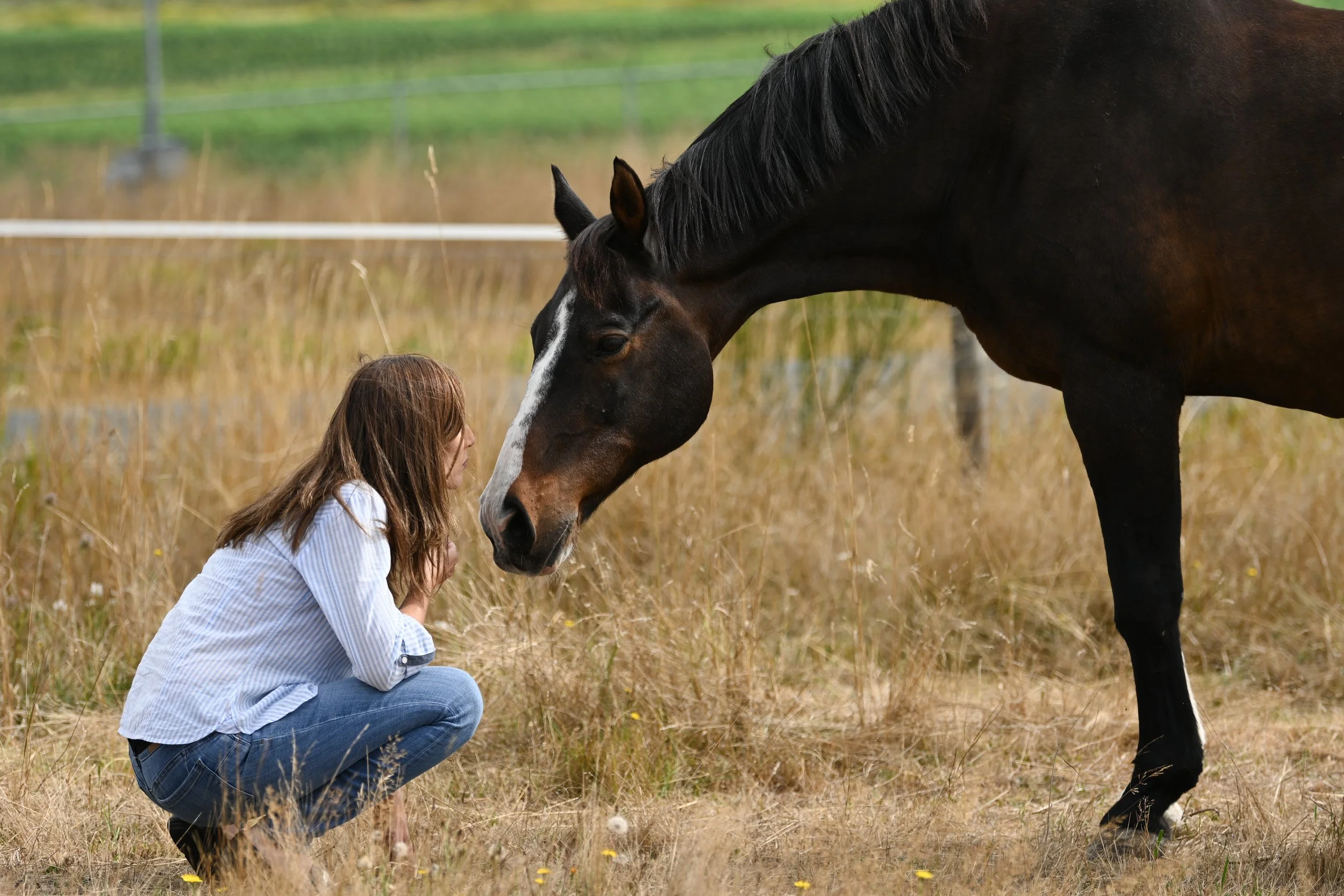
Years ago, a horse called Smokey got loose on the property I was working on.
His delight at the open gate lasted about four seconds, because people immediately started chasing him. There was a highway nearby, so their panic was reasonable. It was also contagious. The more they ran, the higher his adrenaline climbed, and soon he was heading up the hill toward a ring that was not fully enclosed and was closer to the road.
I was on the far side of the property. I could see the whole thing.
I cut through the barn and got to the far fence of that ring a few seconds ahead of him. And then I did the only useful thing available to me, which was nothing. I stopped. I felt my feet on the ground. I slowed my breathing down.
Smokey came across the open ring, put his head over the fence, and stopped with his face inches from mine. He stood there with his heart hammering, and his breathing gradually came down to match mine. When I reached for his halter it was a formality.
He had done what horses do. He went looking for an external state of calm so his own nervous system had something to organize around. I had not caught him. I had just been the calmest thing in the field.
A leader who cannot ground becomes one more source of urgency in the room. A leader who can becomes the thing everyone else regulates to, usually without knowing they are doing it. That is not charisma. It is physiology, and you can train it.

Movement two
Read the Field
Sense the whole landscape, and decide for the safety of the whole.
Under pressure, attention narrows. This is a design feature, not a flaw. Your nervous system is trying to keep you alive, and it does that by shrinking the field to the nearest threat.
It is also why so many senior decisions are made about the loudest problem rather than the most important one.
Reading the field is the trained capacity to widen back out while the pressure is still on. To take in the whole system, including the parts that are quiet, including the parts nobody has escalated yet, and to decide from there. A lead mare does not manage the herd. She reads it. The herd moves because her read is trustworthy.
This is whole picture thinking with a body attached. Most strategic training gives you the first half.
Movement three
Move
Pivot moment to moment, with confidence instead of anxiety.
The plan was correct when you wrote it. The conditions it assumed no longer exist.
Most leaders respond to that by planning harder, which is the same as running faster in wet sand. The skill that actually matters now is not strategy. It is how quickly you can recalibrate when the strategy stops working, and whether you can do it without waiting for a certainty that is not coming.
Move is bottom up and real time. You stop deciding from the neck up. You start deciding from a body that is in contact with the field, and you adjust as the field adjusts, which it will, continuously, for the rest of your career
The science underneath it
None of this is mystical, and I would rather you did not treat it that way.
Grounding works because the autonomic nervous system has two branches and you can influence which one is driving. Co-regulation works because mammals settle in the presence of a settled mammal, which is measurable and which is why Smokey came to the fence. The narrowing of attention under threat is a documented feature of sympathetic arousal. And the reason old patterns hold is neurological patterning, which is also why they can be changed, slowly, through repetition rather than insight alone.
My mindfulness training is through the UCSD Center for Mindfulness, where mPeak was built for elite performers rather than for retreats. The nervous system piece is not a garnish on this method. It is the mechanism.
“I’m not a horse person, so initially I wasn’t sure how working with horses could help me, but I had some major AHAs which I’ve never connected in 20 years of this type of work.”
OPEN · MONTHLY COMMUNITY · ONLINE
Come back to your own read.
You hold the room everywhere else. Open is where you don't have to.
Live classes and meditations, once a month. Second Thursday of every month, starting October 2026.
Ground. Read the whole field. Move in real time.